


 The palaces of Rajasthan are the essence of the heritage of Rajasthan. Serving as the residences of the royal families, these palaces are a perfect blend of Rajput and Mughal architecture. These grand monuments are living reminders of the lifestyle and history of the kings of Rajasthan. These imperial palaces stand not only as independent structures but are even found within several fort complexes. They are true examples of the exquisite architecture of Rajasthan. They encompass beautiful gardens, fountains, temples, durbars, and separate men and women quarters within its fold. Today, most of the palaces serve as heritage hotels and house some of the finest museums of Rajasthan.
After the royal families, the merchants were the most affluent class in Rajasthan. In keeping with their prestige, the merchants got heavily decorated mansions or havelis built as a place of their residence. Like palaces, the havelis are found in almost all the cities of Rajasthan but the mansions of Jaisalmer and Shekhawati region are the most elaborate and popular ones. The havelis of Rajasthan are adorned by beautiful frescoes in vibrant colors of blue, indigo, maroon, red, green, and yellow. The walls of the havelis are a visual treat to the eyes with their beautiful paintings depicting scenes from mythology, daily life, and colorful customs of Rajasthan. The mansions are indeed a reflection of the excellent craftsmanship of Hindu and Muslim workers.
City Palace (Jaipur)
Situated amidst the heart of the walled city, City Palace Jaipur was built by Raja Sawai Jai Singh and extensions were made by the successive rulers. A section of the City Palace still serves as the residence of the royal family of Jaipur, though the ground floor and other sections of the palace currently act as museums and are open for public viewing.
Hawa Mahal (Jaipur)
Hawa Mahal, or The Palace of Winds, is centrally located in Jaipur city and is an unusual structure with 953 small windows at the large wall facing the street, to allow the breeze enter during the hot months of summers. It was built by the poet king Sawai Pratap Singh in 1799 for women of the royal family to view the royal processions on the street below from the palace without being visible themselves.
City Palace (Udaipur)
Built by Maharana Uday Singh, the founder of the city of Udaipur, City Palace has been continuously extended by successive Maharanas but still retains its uniformity. Standing on the east bank of Lake Pichola, the palace can be entered through Hati pol or the elephant gate which further takes one to the other two gates of the palace, the Tripolia - a triple arched gate and Bari pol - the big gate.
Lake Palace (Udaipur)
The summer palace of the Maharana of Udaipur, Lake Palace was built by Maharana Jagat Singh in 1743. Originally known as the Jag Niwas, the palace is built over an entire island in Lake Pichola.
Umaid Bhawan Palace (Jodhpur)
Built in the 20th century, the palace took 15 long years to be completed and is one of the last great palaces to be built in India. The palace derives its name from Maharaja Umaid Singh who was deeply fascinated by western lifestyle and hence, appointed Edwardian Architect, Henry Vaughan Lanchester to build the palace on the Chittar Hills of Jodhpur.
Jal Mahal (Jaipur)
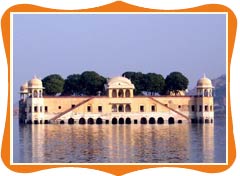
Situated in the centre of the Man Sagar Lake, the Water Palace of Jaipur was built in the 18th century. Built for royal duck shooting parties, the palace has the scenic Nahargarh hill as its background. The five-storied mahal has nearly four stories submerged in water and is entered through a causeway situated in the middle of the Man Sagar Lake. The palace is now abandoned but looks splendid during monsoons.
Lalgarh Palace (Bikaner)
Built by Maharaja Ganga Singh in 1902 in the memory of his father Maharaja Lal Singh, this imposing red stone structure is an architectural marvel of Rajasthan. The palace is an example of hybrid architecture combining Mughal, Rajput, and European styles. The exterior of the palace relates the Rajput tale while the interiors of the palace are distinctly oriental. The palace is an example of superb craftsmanship that is evident from the beautiful latticework and filigree work. Sprawling bougainvilleas in the palace garden and peacocks add to the beauty of the palace. The palace has now been turned into a heritage hotel.
Patwon Ki Haveli (Jaisalmer)
Patwon ki Haveli, or the mansion of the brocade workers, is one of the oldest and most elaborate havelis of Jaisalmer. It has exquisitely carved pillars, corridors, and chambers, and is known for its beautiful jharokhas or balconies. The five-storied haveli is divided into six apartments - two owned by Archaeological Survey of India, two by families who operate crafts shop, and two private homes.
Salim Singh Ki Haveli (Jaisalmer)
Named after the Prime Minister of Jaisalmer Salim Singh the haveli is nearly 300 years old. The mansion has a beautiful arched roof with superbly carved brackets in the form of peacocks. The front faade of the haveli resembles a ship stern; hence, the haveli is also referred to as the jahaz mahal. Two sandstone tuskers guard the entrance of the haveli. The haveli consists of as many as 38 balconies, all built in distinct styles. Legend has it that the minister wanted to get the haveli built of the same height as that of the palace of the Maharaja but the king did not agree and got the two stories torn down.
Nathmlalji Ki Haveli (Jaisalmer)
One of the ostentatious and recent haveli of Jaisalmer was built in 1885 AD by the architect brothers Lulu and Hathi. The haveli has a unique story to tell about its construction. The two architect brothers took to left and right size respectively for constructing the haveli, yet the haveli boasts of striking symmetry. Life-size replica of elephants in yellow sandstone guards the entrance of the haveli. The right and left wing of the haveli are adorned by miniature paintings of flora, cattle, and horses.
Nawalgarh Havelis (Shekhawati)
Referred to as the Open Art Gallery of Rajasthan due to magnificent murals and frescoes from mythology, legendary tales, and contemporary lifestyle adorning them, the havelis of Nawalgarh are a visual treat to the spectators. On the west of the Nawalgarh Fort are a group of havelis, known as aath havelis, depicting the life-size paintings of camel, horses, and elephants. Krishna legends in the form of miniature paintings adorn the walls of Murarka haveli, opposite the aath haveli. To the north is the Hem Raj Kulwal haveli which you can enter through an ornate silver door. Other notable havelis are Bhagton ki Choti Haveli, Parusrampuria Haveli, Dharni Dhakra Haveli, Chhauchharia Haveli, Hira Lal Sarowgi Haveli, and Geevrajka. The interiors of these havelis have a vibrant riot of colors, bewitching you with their beauty. Most of these havelis belonged to the affluent merchant class of the region and truly reflect their ostentatious lifestyle.
Mandawa Havelis (Shekhawati)
Mandawa havelis are the second Open Art Gallery of Rajasthan, similar to the havelis of Nawalgarh, in terms of beautiful frescoes and murals which add beauty to these havelis. Built in the Jaipur style of architecture, there are pleasant courtyards, gardens, and balconies with splendid views of Mandawa Fort which one can capture from the Mandawa havelis. Displaying the skillful craftsmanship of Rajput artisans is the Goenka Double haveli. The haveli is adorned by life-sized portraits of royal men, traditional Rajasthani women, and religious motifs. The haveli has monumental faade of elephants and horses and has two principal gateways. The Hanuman Prasad Goenka Haveli has religiously inspired frescoes, like Lord Shiva on Nandi and Lord Indra on his elephant.
Jhunjhunwala Haveli
Jhunjhunwala Haveli is famous for its intricately carved and painted ceilings and golden leaf painted walls. Paintings of Lord Krishna with the gopis (milkmaids) also adorn the walls. Carved archways, latticed windows, and intricate designs are found in Murmuria haveli as well. Besides traditional frescoes and murals, the Murmuria haveli has modern paintings also, like the one depicting Jawaharlal Nehru with the National Flag on a horseback. Mohanlal Saraf Haveli, Chowkhani Haveli, Bhagchandika Haveli, Gulab Rai Ladia Haveli, Lakshmi Narayan Ladia Haveli, and Newtia Haveli are some other majestic havelis of Mandawa.
Fateh Prakash Palace (Udaipur)
Located at the shore of Lake Pichola, the palace is named after the great ruler of Mewar, Maharana Fateh Singh who once resided in the palace. The corridors of the palace are adorned by huge paintings of the Mewar style of art which were lavishly patronized between the 17th and 19th centuries. The palace houses one of the most splendid durbar halls of India. The main attraction of the durbar is the huge chandelier in the middle of the hall. There are a number of galleries around the hall for women to view the proceedings in the hall. The durbar is embellished by weapons and life-size paintings of the Maharanas of Mewar. The crystal gallery of the palace has no match to it, housing some unique art pieces.
City Palace (Alwar)
The palace was built in 1793 AD by Raja Bakhtawar Singh. It is a unique blend of Mughal and Rajput style of architecture. Once the residence for the royalty, the palace has now been converted partly into a district government office while the second floor is transformed into a museum. A marvelous Chattri with Bengali roof and arches, also known as Moosi Maharani ki Chattri, adorns the palace. The entire palace is adorned with lovely artwork. The presence of a picturesque garden Purjan Vihar (Company Garden), laid during the reign of Maharaja Shiva Dan Singh in 1868 AD, adds to the beauty of the palace. It also houses an impressive museum consisting of magnificent antiques.


