


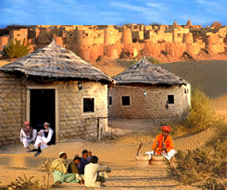
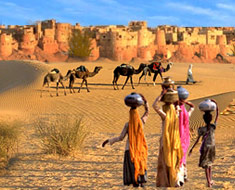
 There is no point of debate on Rajasthan being one the foremost states which can boast of brilliant architecture. The architectural marvel can be found in every part of Rajasthan in the form of numerous forts, palaces, temples, havelis (mansions), and even simple houses of the local people. These monuments are living reminiscence of the Islamic, Rajput, and European architectures. These monuments were built keeping in mind the various purposes they served - a residence for the royalty, defense and garrison purpose, and religious needs of the local population.
The monuments of Rajasthan are an example of the romance of the kings of Rajputana with the cities and times in which they lived. The intricate carvings and difficult terrains, in which the monuments were built, reflect an unusual blend of toughness and compassion the Rajput kings held. The numerous forts and palaces, today, tell us the tales of the legendary and chivalrous kings of Rajasthan. Browse on further to discover some of the plethora of monuments resting in Rajasthan.
Jaigarh Fort (Jaipur)
Jaigarh Fort, also known as the fort of victory, is one of the three hilltop forts that overlook Jaipur. Situated approximately 15 km away from Jaipur, the fort was constructed between the 15th and 18th centuries. The fort is clearly a military structure as can be comprehended by its citadel kind of architectural style.
Amber Fort (Jaipur)
Constructed by Raja Man Singh I in 1592 and completed by Raja Sawai Jai Singh I, the fort is a fantastic blend of Mughal and Rajput architecture at its best. Made in red sandstone and white marble, the fort provides the spectators a magnificent sight.
Kumbhalgarh Fort (Udaipur)
Constructed in the 15th century by Raja Kumbha, the fort is located 64 km north of Udaipur. Like Chittorgarh, it is one of the most significant citadels of Udaipur. Kumbhalgarh Fort is famous for the birth of the legendary Rajput king, Maharana Pratap of Mewar.
Mehrangarh Fort (Jodhpur)
Built in 1459 by Rao Jodha and continuously being extended by other rulers of the royal house of Jodhpur till the 19th century, the Mehrangarh Fort is one of the most magnificent and impressive forts of India. It is also one of the most well maintained forts of Rajasthan.
Jaisalmer Fort, Sonar Quila (Jaisalmer)
The Sonar Quila, or the Golden Fort, is ideally named so due to its location in the land of golden sand dunes of Thar Desert. Made of yellow sandstone, when the sunrays fall on the fort, it shines like bewitching gold. The fort is a city complex in itself consisting of palaces, security sources, havelis (mansions) of rich merchants, temples, and residential complexes of the army.
Umaid Bhawan Palace (Jodhpur)
Built in the 20th century, the palace took 16 long years for completion and is one of the last great palaces to be built in India. The palace derives its name from Maharaja Umaid Singh, who was deeply fascinated by western lifestyle and hence, appointed the Edwardian architect, Henry Vaughan Lanchester to build the palace on the Chittar hills of Jodhpur.
City Palace (Jaipur)
Situated amidst the heart of the walled city, City Palace was built by Raja Sawai Jai Singh, with extensions made by the successive rulers. A section of the City Palace still serves as the residence of the royal family of Jaipur, though the ground floor and other sections of the palace are open for public viewing and currently act as museums.
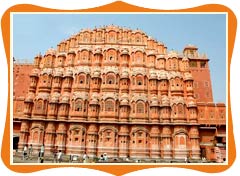
Hawa Mahal (Jaipur)
The Palace of Winds is centrally located in the city of Jaipur and is an unusual structure with 953 small windows on the large wall, facing the street, to allow the breeze to enter in the hot months of summers.
City Palace (Udaipur)
Built by Maharana Uday Singh, the founder of the city of Udaipur, City Palace has been continuously extended by successive Maharanas, but still retains its uniformity. Standing on the east bank of Lake Pichola, the palace can be entered through Hati pol, or the elephant gate, which further takes one to the other two gates of the palace - the Tripolia, a triple arched gate, and Bari pol, the big gate.
Lake Palace (Udaipur)
The summer palace of the Maharana of Udaipur, Lake Palace was built by Maharana Jagat Singh in 1743. Originally known as the Jag Niwas, the palace is built over an entire island above Lake Pichola.
Nahargarh Fort (Jaipur)
Situated atop the rugged terrain of Aravali, the Nahargarh Fort was built by Raja Jai Singh in 1734 with extensions being made in 1868. This was the first fort to be built by the kings of Jaipur. The Nahargarh Fort literally means the abode of tigers. Unfortunately, the fort is now almost in ruins due to lack of maintenance but gives an excellent erstwhile feel. The only well preserved structure of the fort is Madhavendra Bhawan built by Sawai Ram Singh II, consisting of a head suit for the king and twelve identical suits for his queens.
Chittorgarh Fort (Udaipur)
Chittorgarh Fort is an excellent example of military fortifications. It lies 157 km from Udaipur and has seven entrance gates. Ram pol and Suraj pol are the two main entrances to the fort. Legend has it that it was Bhim - the Pandava, who started the construction of Chittorgarh Fort. Within the fort complex are several palaces like the Fateh Prakash Palace, Rana Kumbha Palace, Ratan Singh Palace, and Rani Padmini Palace. In 1567 when the Mughal Emperor laid siege on the fort, Raja Udaisingh went into exile and since then, the fort was never resettled.
Junagarh Fort (Bikaner)
Built in 1593 AD by Raja Rai Singh, it is one of the rare forts of Rajasthan which is not built on a hill top. There is a moat encircled around the fort for its defense. The fort, so far, has remained the unconquered fort of Rajasthan. The fort can be entered only by two gateways, the main entrance - Karan pol, and the other entrance - Suraj pol or the sun gate. The ambience of this fort is so majestic and spell-binding that you never get enough of its magnificent beauty and impeccable architecture.
Kishangarh Fort (Ajmer)
Built in 1649 by Maharaja Roop Singh, the fort is named after its ruler and is popularly known as Roopangarh Fort. The nine turreted fortifications encompass within it several battlements, jails, granaries, armories, and foundries. The double height Durbar Hall has latticed windows above for the queens to view the proceedings carried below. The fort has witnessed many of the patronizing deeds of its rulers towards art, architecture, music, and poetry. Another structure which offers a magnetic appeal to the fort is the Phool Mahal, or the Flower Palace. The fort is worth a visit when one visits the city of Ajmer-Pushkar.
Taragarh Fort (Ajmer-Pushkar)
Built in 1345, the fort is situated in the centre of the state of Rajasthan. The fort has fascinating six gateways and Miran Saheb ki Dargah within its complex. On the largest rampart of the fort is a famous canon called Bhim Burj. Historically, in times of war and siege, the fort acted as a safe haven for people of the city. There are stunning large reservoirs built within the fort to store water in times of siege. The beautiful fort stands erect even today at the Nagpahari hill of Aravali ranges.
Rajasthan Palaces and Havelis
The palaces of Rajasthan are the essence of the heritage of this deserted city. Serving as the residences of the royal families, the palaces are a perfect blend of Rajput and Mughal architectures. Today, most of the palaces serve as heritage hotels and house some of the finest museums of Rajasthan. After the royal house, the merchants were the most affluent class in Rajasthan. In keeping with their prestige, the merchants got heavily decorated mansions or havelis built as a place of their residence. The mansions of Jaisalmer and Shekhawati region are the most elaborate and popular ones.
Jal Mahal (Jaipur)
Situated in the centre of the Man Sagar Lake, the Water Palace of Jaipur was built in the 18th century. Built for royal duck shooting parties, the palace has the scenic Nahargarh hill in the backdrop. The five-storied mahal has nearly four stories submerged in water and is entered through a causeway situated in the middle of the Man Sagar Lake. The palace is now abandoned but looks splendid during monsoons. For photographers, the site serves as a true paradise.
Fateh Prakash Palace (Udaipur)
Located on the shores of Lake Pichola, the palace is named after the great ruler of Mewar, Maharana Fateh Singh who once resided in the palace. The corridors of the palace are adorned by extremely alluring and impressing huge paintings in the Mewar style of art, which were lavishly patronized between the 17th and 19th centuries. The palace houses one of the most splendid Durbar Halls of India. Fateh Prakash Palace is definitely a worth visiting art piece.
City Palace (Alwar)
Vinay Vilas Mahal, or the City Palace Alwar, was built in 1793 AD by Raja Bakhtawar Singh. The palace is uniquely a blend of Mughal and Rajput styles of architecture. The central courtyard has graceful marble pavilions set on lotus flower bases. Once the residence for the royalty, the palace is now converted partly into the district government office, while the second floor is transformed into a museum. In the vicinity of the palace is an artificial lake built by Maharaja Vinay Singh in 1815.
Lalgarh Palace (Bikaner)
Built by Maharaja Ganga Singh in 1902 in the memory of his father Maharaja Lal Singh, the imposing red stone structure is an architectural marvel of Rajasthan. The palace is an example of hybrid architecture combining Mughal, Rajput, and European styles. This oriental fantasy, designed by Sir Swinton Jacob, can be categorized as the Indo-Saracenic style of architecture. The exteriors of the palace recount the Rajput tales while the interiors are distinctly oriental.
Patwon Ki Haveli (Jaisalmer)
Patwon ki Haveli, or the mansion of the brocade workers, is one of the oldest and most elaborate havelis of Jaisalmer. Housing exquisitely carved pillars, corridors, and chambers, the haveli is known for its beautiful jharokhas or balconies. The five-storied haveli is divided into six apartments, two owned by Archaeological Survey of India, two by families who operate crafts shop, and two serve as private homes. Jaisalmer is dotted with several stunning mansions, each of them showcasing a distinct and unique style of architecture.
Salim Singh ki Haveli (Jaisalmer)
Named after the Prime Minister of Jaisalmer, Salim Singh, the haveli is nearly 300 years old. The mansion has a beautiful arched roof with superbly carved brackets in the form of peacocks. The front faade of the haveli resembles a ship stern; hence, the haveli is also referred to as the Jahaz Mahal. Vivacious, exquisite, and stylish murals on the walls of the haveli mark an extra charm to this picturesque mansion. Salim Singh ki Haveli was home to the members of the Mohta family for several decades.
Nathmlal Ki Haveli
One of the ostentatious and recent havelis of Jaisalmer to be built in 1885 AD by the architect brothers Lulu and Hathi, the haveli has a unique story to relate about its construction. The two architect brothers took to left and right size respectively for constructing the haveli, yet the haveli boasts of striking symmetry. The architecture of this building displays a unique fusion of Islamic and Rajput styles of architecture. The haveli is stunningly adorned and the entrance is marked by two huge and amazingly carved yellow-stoned elephants.
Nawalgarh Havelis (Shekhawati)
Referred to as the Open Art Gallery of Rajasthan due to magnificent murals and frescoes from mythology, legendary tales, and contemporary lifestyle, the havelis of Nawalgarh are a visual treat to the spectators. On the west of the Nawalgarh Fort are a group of havelis known as aath havelis. The haveli depicts the life-size paintings of camels, horses, and elephants. Other notable havelis are Bhagton ki choti Haveli, Parusrampuria Haveli, Dharni Dhakra Haveli, Chhauchharia Haveli, Hira Lal Sarowgi Haveli, and Geevrajka Haveli which are all art galleries in themselves.
Mandawa Havelis (Shekhawati)
The second Open Art Gallery of Rajasthan, the havelis of Mandawa are similar to the havelis of Nawalgarh in terms of beautiful frescoes and murals which add beauty to these havelis. Built in the exceptionally intricate Jaipur style of architecture, there are pleasant courtyards, lush green gardens, and wide balconies with splendid views of Nahargarh Fort which one gets from Mandawa havelis. Visitors have a marvelous opportunity to click some of their best pictures against awesome backdrops.


