


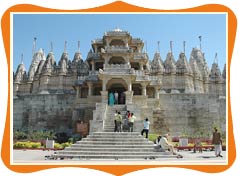
 The temples of Rajasthan are a testimony to the great architectural movement which has gripped the state since the 8th century. The temples are a symbol of the religious belief and faith of the people of Rajasthan. These holy sites, besides being the place of religious worship, are the meeting grounds of people to celebrate traditions and festivals of Rajasthan. The common thread which runs in these temples is the single shikhara, or spire, and intricately carved outer chamber called the mandap before the inner sanctum. The temples of Rajasthan are exquisitely carved and sculptured and are beautiful structures to view. These holy shrines are said to be found in almost all the cities, towns, and villages of Rajasthan and thus, are deeply a part of the Rajasthani culture.
Dilwara Temples (Mount Abu)
The example of the most exquisitely carved temples of Rajasthan is, undoubtedly, the Dilwara Jain temples of Mount Abu. This is the principal place of pilgrimage for Jains in India. Built in marble, the Dilwara temples were constructed between the 11th and 13th centuries.
Govind Devji Temple (Jaipur)
This royal temple, dedicated to Lord Krishna and Goddess Radha, is located in the City Palace complex. It was Raja Sawai Jai Singh who is believed to have brought the image of Govind Devji (Lord Krishna) to Jaipur from Vrindavan. It is a delight to visit the temple on the festival of Janmashthami when the deities are dressed up in all the fineries, accompanied by the enchanting aarti (prayer in singing form) and bhog. The connection one feels with the divine here is the true calling for visitors.
Galtaji Temple (Jaipur)
Etched in pink hued sandstone, Galtaji is one of the most popular places of pilgrimage in Rajasthan. Dedicated to the Sun God, the temple is also known as the Monkey Temple. The temple was constructed by Diwan Kriparam, an attendant of Raja Sawai Jai Singh II. Housing three holy tanks, people throng to the temple to take a holy dip in the water coming from gaumukh. There are several other temples and holy water springs near the Sun Temple to which ardent devotees visit in large numbers.
Birla Lakshmi-Narayan Temple (Jaipur)
Constructed by the illustrious Industrialist family of the Birlas, the temple, as the name suggests, is dedicated to Lakshmi Nararyan. Built in pure white marble, the temple is one of the recently constructed temples of Rajasthan. The temple is built on an elevated plain and is surrounded by well manicured gardens. The temple complex houses deities in other small shrines and the walls are adorned by intricate carvings from mythological and religious texts. The temple happens to be one of the major attractions of Jaipur where not only devotees but tourists also turn up in a big way.
Brahma Temple (Pushkar)
The abode of Lord Brahma and the only temple in the world dedicated to the creator is located in Pushkar. The temple is believed to be dating back to the 14th century and stands on a high plinth with marble steps leading to the inner sanctum. The silver inlaid marble archways and the elaborately carved swans are all a delight to watch. The temple is beautifully adorned with an alluringly carved silver turtle which sits on the floor facing the inner sanctum or the garbhagriha. The turtle is surrounded by hundreds of silver coins with the names of donors engraved on them.
Osian Temples (Jodhpur)
The desert oasis has nearly 16 Brahmanical and Jain temples which are popular for their intricate carvings and heavy sculpting. The medieval age structures are all in red sandstone with soaring pinnacles, raised pedestals, and pillars. The Sun Temple is the oldest of Osian temples dating back to the 10th century and has carvings similar to that of the Konark Temple. The Sachiyamata Temple, or the Durga Temple, and the Mahavira Temple are the two other prominent temples of Osian. However, most of the temples are now in ruins and require conservation efforts.
Eklingji Temple (Udaipur)
The chief deity of the Maharanas of Mewar since the time of Bappa Rawal, Eklingji (a form of Shiva deity) is one of the principal pilgrimage destinations in Rajasthan. Having 108 small shrines in marble and red sandstone, the Eklingji temple was built in 734 AD. These shrines are dedicated to Parvati - the wife of Lord Shiva, Ganesh, Kartikeya, the holy rivers Ganga and Yamuna, Amba and Kalka Mata. The main shrine has the Chaumukhi, the qaudriform divinity, the four faced black marble images of Brahma, Vishnu, Maheshwar, and Surya.
Shree Nathji Temple-Nathdwara (Udaipur)
The Gate of Lord Nathdwara is one of the principal places of pilgrimages for Hindus. The temple of Shree Nathji (Lord Krishna) was built in the 17th century at the spot decided by the lord himself. The idol of Shri Nathji is carved out of a single black marble and has its one arm risen as if it is holding the Govardhan Mountain while the other arm is placed as if it is showering blessings. Legend has it that due to destruction of temples by Mughal Emperor Aurangzeb, the image of Lord Krishna was transferred from Vrindavan and the chariot carrying the image got stuck at the place where the lord wanted the temple to be built.
Mehandipur Balaji Temple (Dausa)
The temple is a unique marvel as the deity of Mehandipur Balaji Temple is believed to be having divine powers and has the capability of miraculously curing the person possessed by evil spirits. Though medical science does not believe in such cure, still thousands of people throng the temple with nothing but faith, and astonishingly many have been cured of their problems. The temple witnesses thousands of devotees all round the year. Its exclusively impeccable designs and divine mystical powers create an amazing sight.
Ranakpur Jain Temples (Udaipur)
One of the five holy places of Jains, the Ranakpur temples were created in the 15th century during the reign of Rana Kumbha. The temples are located in the Aravali hill ranges of the Pali district. The main temple is the Chaumukha Temple (four faced temple) dedicated to Adinathji, the 1st Jain tirthankar. The temple has 29 elaborate halls and 1,144 intricately carved pillars which make it an architectural marvel. The other temples in the complex are Parsavnath and Neminath temples with exquisitely sculpted figurines.
Karni Mata Temple-Deshnok (Bikaner)
The temple, dedicated to a 15th century incarnation of Goddess Durga, is a unique temple as it has thousands of rodents in the temple complex who are worshipped here. With this, the temple has gained popularly as the Rat Temple. The temple entrance has a beautiful marble faade to which huge silver doors were added by Maharaja Ganga Singh. It is considered highly auspicious if a rat, or the holy Kaba as it is known, runs over your feet in the temple. This unusual temple is all decked up during the holy days of Navratri when a major fair is organized here.


